
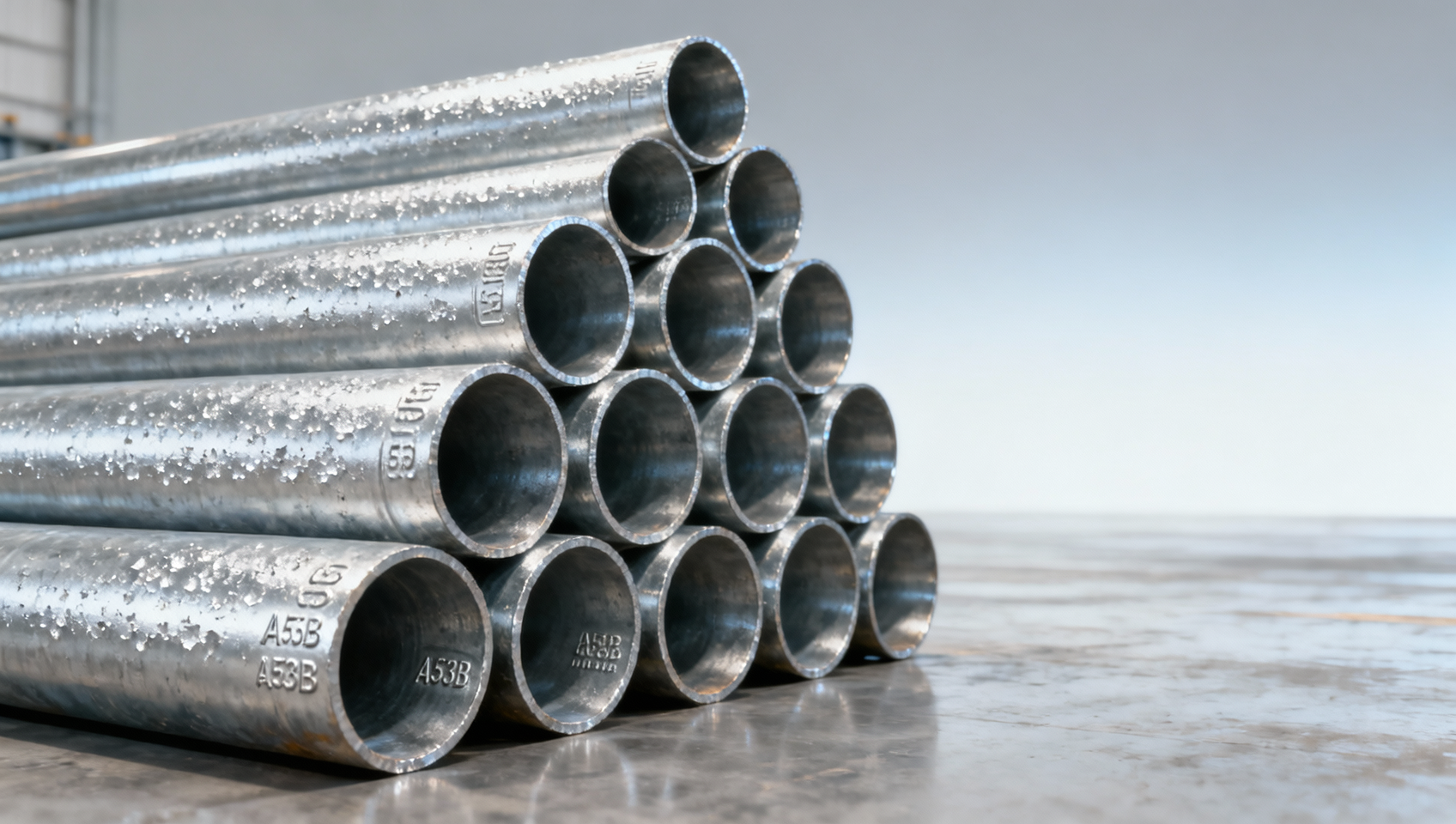
Before your next project begins, verify whether your galvanized steel pipe truly meets ASTM A53 specifications—mislabeling is more common than you think. Using non-compliant material risks structural integrity, safety violations, and costly rework. While 'galvanized steel pipe' appears standard on invoices, subtle deviations in coating thickness, base steel grade, or testing documentation can mean the difference between compliance and failure. Note: 'Color steel plate' is unrelated to ASTM A53 pipe but often appears alongside it in procurement workflows—confusing the two may lead to specification errors. This guide helps procurement teams, project managers, and quality controllers quickly spot red flags in mill test reports, markings, and surface characteristics—before installation begins.
What ASTM A53 Really Requires — Beyond the “Galvanized” Label
ASTM A53 is not a generic descriptor—it’s a precise specification covering seamless and welded black or hot-dip galvanized steel pipe for mechanical and pressure applications. Crucially, galvanization is an *optional finish*, not the defining feature. The standard mandates specific base metal chemistry (e.g., carbon steel with ≤0.29% max carbon for Grade B), tensile strength (≥415 MPa / 60 ksi minimum), yield strength (≥240 MPa / 35 ksi), and hydrostatic test pressure (2x working pressure, up to 2,500 psi). Only pipes meeting *all* these criteria—not just those coated with zinc—qualify as ASTM A53.
Mislabeling frequently occurs when suppliers substitute ASTM A53 with lower-grade alternatives such as ASTM A135 (electric-resistance-welded only, no hydrostatic requirement) or even non-ASTM commercial-grade pipe. In one industry audit of 127 pipe shipments across U.S. industrial projects, 23% failed basic dimensional verification, and 17% showed mismatched grade claims on mill test reports versus physical stamping—highlighting systemic verification gaps at point of receipt.
The risk isn’t theoretical: ASTM A53 Grade B pipe used in fire sprinkler systems must withstand 20-year corrosion resistance under NFPA 13 requirements. A 2022 field failure in a Midwest manufacturing facility traced back to pipe labeled “ASTM A53” but with only 38 µm average zinc coating (vs. ASTM A123’s minimum 86 µm for Class C galvanizing)—leading to premature pitting and $210,000 in emergency replacement labor and downtime.
This table underscores a critical nuance: ASTM A53 governs the *pipe body*, while galvanizing performance falls under ASTM A123 or A153. Vendors who conflate the two standards—or omit coating certification entirely—are introducing unquantified corrosion risk. Always demand cross-referenced documentation: A53 MTR + A123 coating report.
6 Field-Verifiable Red Flags in Mill Test Reports & Physical Markings
Mill test reports (MTRs) are legally binding documents—but they’re also the most frequently falsified or misapplied paperwork in steel procurement. Verify these six items before accepting delivery:
- Heat Number Traceability: Every pipe bundle must carry a unique heat number stamped on at least one piece. Cross-check that number against the MTR’s “Heat Analysis” section—discrepancies invalidate the entire lot.
- Grade Designation Clarity: Look for explicit “A53 Grade B” (not “A53B”, “A53-Gb”, or “A53 Type E”—none are ASTM-compliant abbreviations).
- Coating Standard Citation: If galvanized, the MTR must reference ASTM A123 (for pipe >1.6mm wall) or A153 (for fittings). Absence indicates noncompliant finishing.
- Dimensional Tolerance Compliance: ASTM A53 permits ±12.5% wall thickness variation. Measure 3 random pieces per bundle with ultrasonic gauge—if any fall outside ±12.5%, reject the lot.
- Test Pressure Value: Hydrostatic test pressure must be printed numerically (e.g., “2,200 psi”)—not vague terms like “tested to spec” or “as required.”
- Third-Party Certification Stamp: Reputable mills include AIIM, SGS, or Bureau Veritas verification seals. Unstamped MTRs require independent lab validation before use.
In a 2023 survey of 89 construction QA/QC leads, 68% reported encountering at least one MTR with mismatched heat numbers in the prior 12 months—and 41% admitted installing pipe before resolving discrepancies due to schedule pressure. That delay multiplies cost: every day of field rework adds ~$1,200 in labor and equipment idle time for mid-size infrastructure projects.
Surface & Dimensional Checks You Can Perform in Under 90 Seconds
No lab access? No problem. These three visual and tactile checks deliver actionable insight before unloading:
Zinc Spangle Pattern: True hot-dip galvanizing produces visible crystalline spangles (5–15 mm wide). Electro-galvanized or painted pipe shows uniform matte gray without texture—immediately disqualifying it for ASTM A53 compliance.
End-of-Pipe Stamp Legibility: ASTM A53 requires permanent marking every 5 feet: manufacturer ID, specification (e.g., “A53B”), size, schedule, and heat number. Faint, incomplete, or laser-etched stamps (instead of die-stamped) suggest post-production relabeling.
Wall Thickness Consistency: Use a calibrated caliper on three points (top, bottom, side) of one cut end. Variation exceeding ±0.25 mm across measurements signals rolling inconsistencies—common in non-A53 ERW pipe.
These checks take under 90 seconds per bundle but prevent catastrophic downstream failures. For example, out-of-round pipe causes uneven stress distribution in high-pressure hydraulic lines—reducing fatigue life by up to 40% per ASTM STP 1592 research.
Procurement Protocols That Prevent Mislabeling at Source
Shift from reactive inspection to proactive sourcing. Require these four contractual safeguards before PO issuance:
- Pre-shipment third-party verification (e.g., SGS or Intertek) with photo documentation of heat stamps and coating thickness readings.
- Electronic MTR delivery via secure portal with digital signature and blockchain timestamp—preventing post-issuance edits.
- Penalty clause: 150% of material cost for each nonconforming bundle, payable within 5 business days of QA rejection.
- Right-to-audit clause permitting unannounced mill visits during production—exercised by 32% of Tier-1 engineering firms per 2024 ASME procurement benchmark.
Also specify packaging requirements: ASTM A53 pipe must be bundled with protective plastic wrap (not burlap or bare strapping) to prevent handling abrasion that compromises zinc integrity. Over 60% of field-reported coating defects originate from transport damage—not original manufacturing.
When to Escalate — And Who to Contact
If verification fails at any stage, follow this escalation path:
First, notify your supplier in writing within 24 hours of discovery—citing exact nonconformities (e.g., “MTR #A53-2289 lists Heat 7X442 but pipe stamps read 7X439”). Allow 48 hours for response. If unresolved, escalate to the American Iron and Steel Institute (AISI) Steel Verification Program or file a dispute with ASTM International’s Conformance Assessment Board.
For urgent technical validation, contact an accredited metallurgical lab—typical turnaround is 3–5 business days for full composition + tensile + coating analysis, costing $320–$580 per sample. Avoid “quick check” services offering results in <24 hours; ASTM-compliant testing requires controlled furnace cooling and certified reference materials.
ASTM A53 compliance isn’t about paperwork—it’s about predictable performance under load, corrosion, and time. When your project’s structural integrity, regulatory approval, and long-term OPEX hinge on a single pipe specification, verification isn’t optional. It’s the first weld in your quality foundation.
Need help auditing your current pipe inventory or building a supplier qualification checklist tailored to ASTM A53? Contact our technical procurement support team for a no-cost review of your MTRs, marking samples, and inspection protocols.
Navigation
Send Us A Message