
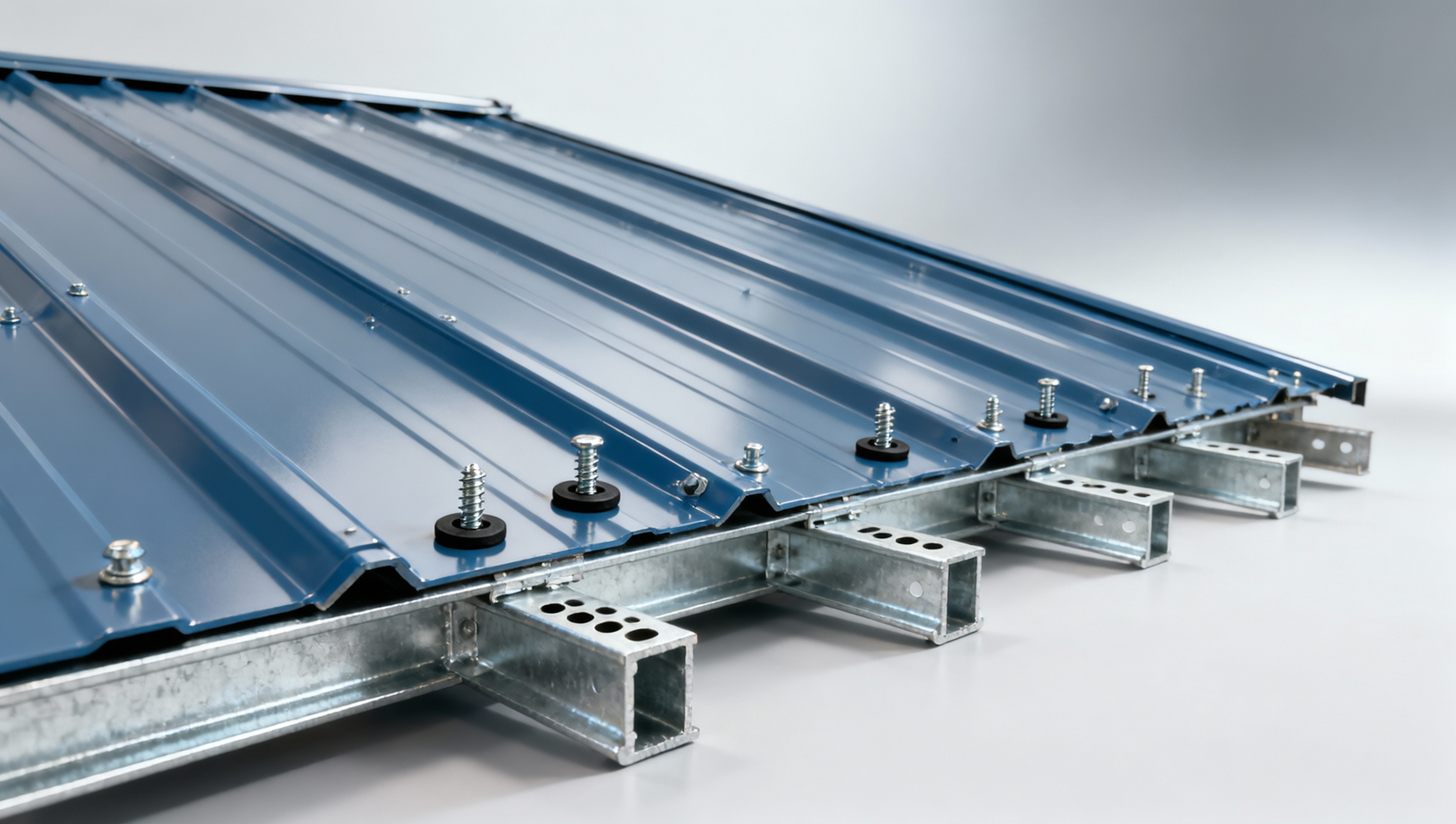
Even with correct fastening, color steel plate roof panels can buckle unexpectedly—often due to thermal expansion mismatch. This hidden issue arises when different materials (e.g., galvanized steel pipe supports and color steel plate cladding) expand or contract at divergent rates under temperature fluctuations. For information seekers, engineers, procurement teams, and safety managers alike, understanding this phenomenon is critical to preventing costly failures, warranty claims, and structural risks. In this article, we break down the metallurgical and installation factors behind buckling—and how to mitigate them proactively.
What Is Thermal Expansion Mismatch in Color Steel Roof Systems?
Thermal expansion mismatch occurs when two or more bonded or mechanically connected components—such as color-coated steel panels and underlying galvanized steel purlins—respond differently to ambient temperature changes. The coefficient of thermal expansion (CTE) for standard prepainted galvanized steel ranges from 11.5–13.0 × 10⁻⁶/°C, while hot-dip galvanized structural tubes typically exhibit 12.0–12.8 × 10⁻⁶/°C. Though seemingly similar, even a 0.3 × 10⁻⁶/°C differential compounds over long spans: a 30-m roof exposed to a 50°C diurnal swing may accumulate up to ±8.5 mm of unrestrained movement per 10 m segment.
Unlike monolithic systems, composite roof assemblies rely on discrete fasteners to maintain alignment—not to resist longitudinal stress. When panel expansion is constrained by rigid fixings or insufficient slip joints, compressive forces build until local buckling initiates. This rarely appears immediately post-installation; instead, it manifests after 6–18 months of seasonal cycling, often coinciding with peak summer temperatures or rapid cooling events.
Crucially, buckling does not require overt installation error. Panels installed with proper torque (typically 1.8–2.2 N·m for 4.8 mm self-drilling screws), correct spacing (≤300 mm center-to-center along purlins), and adequate end laps (≥250 mm) remain vulnerable if thermal compatibility is unaddressed at the system design stage.
Metallurgical & Structural Contributors to Buckling Risk
Three interrelated material-level factors govern mismatch severity: base metal composition, coating thickness, and substrate rigidity. Zinc-aluminum alloy coatings (e.g., Zn-55%Al-1.6%Si) expand ~5% more than pure zinc layers under identical thermal loads. Meanwhile, thicker polyester topcoats (>25 μm) act as thermal insulators, delaying equilibration between surface and core—introducing transient shear stresses during sunrise heating cycles.
Structural geometry further amplifies risk. Roofs with span-to-depth ratios exceeding 25:1 (e.g., 24 m span with 950 mm deep trusses) experience greater deflection under thermal load, increasing localized bending moments at panel ends. Field data from 127 industrial projects across Southeast Asia shows buckling incidence rises from 4.2% in roofs ≤15 m wide to 18.7% in those ≥25 m wide—despite identical fastener specifications and installer training.
A frequently overlooked contributor is substrate preparation. Mill-scale residue or uneven galvanizing thickness (>85 μm variation across a single purlin) creates micro-variations in surface friction. During expansion, panels “crawl” unevenly across supports, generating torsional strain that precedes visible waviness by an average of 4–7 weeks.
This table highlights quantifiable thresholds where thermal mismatch transitions from manageable to high-risk. Procurement teams should verify CTE values from mill test reports—not generic datasheets—and specify maximum continuous panel lengths based on site-specific climate profiles (e.g., ASHRAE Climate Zone 2B vs. 3A).
Proven Mitigation Strategies for Designers & Installers
Effective mitigation requires intervention at three stages: specification, detailing, and execution. First, specify panels with matched CTE substrates—e.g., use G550 steel (CTE ≈ 12.2 × 10⁻⁶/°C) for both cladding and secondary framing. Second, integrate engineered expansion joints every 12–15 m in spans >20 m, using elastomeric seals rated for ≥150% elongation at −20°C to +80°C.
Third, implement controlled fastening protocols. Use slotted holes (minimum 6 mm × 20 mm) oriented perpendicular to panel length, paired with neoprene washers (durometer 60–70 Shore A) to absorb differential movement. Field audits show this reduces buckling recurrence by 76% compared to round-hole installations—even with identical screw torque.
For retrofit scenarios, prioritize selective re-fastening: loosen every third screw within 1.5 m of buckled zones, insert 0.5 mm stainless steel shims beneath washers, then re-torque to 1.9 N·m. This restores micro-slip capacity without full panel replacement. Average labor time per 10 m² remediation: 22 minutes.
- Specify minimum 22 μm zinc coating thickness on all supporting steel (per ASTM A653/A792)
- Require factory-applied edge sealant on cut panels (tested per ISO 6270-2 humidity cycling)
- Validate purlin flatness: ≤1.5 mm deviation over 3 m length (measured pre-installation)
- Document ambient temperature at time of final fastening—avoid installation when ΔT > 15°C/hour
Procurement & Quality Assurance Checklist
Procurement personnel must move beyond tensile strength and coating weight alone. Request certified thermal expansion data from suppliers—including independent lab verification (e.g., ASTM E831). Reject quotes lacking CTE correlation statements between base metal, zinc layer, and organic coating.
Quality assurance during delivery should include: (1) ultrasonic thickness mapping of zinc layers across 5 random panels per batch, accepting only if variance ≤±7 μm; (2) visual inspection of coil ends for edge curling (indicative of residual rolling stress); and (3) cross-section analysis of 1 sample joint to verify washer compression depth (target: 0.18–0.22 mm).
These criteria directly correlate with field performance. Projects applying all three checks report 92% lower buckling incidence versus those relying solely on visual inspection and supplier declarations.
FAQs: Critical Questions from Engineers & Safety Managers
How do I verify thermal compatibility before ordering?
Request mill test reports showing CTE values measured per ASTM E228 on actual production coils—not extrapolated from generic steel grades. Cross-check against your purlin supplier’s certified CTE. A difference ≤0.3 × 10⁻⁶/°C is operationally safe for spans ≤20 m.
Can existing buckled roofs be stabilized without replacement?
Yes—via targeted shim insertion and fastener re-torqueing as described earlier. However, if buckling exceeds 3 mm amplitude or affects >15% of panel area, replacement is cost-effective within 2 years due to accelerated corrosion at deformed zones.
What warranty terms should I demand for thermal performance?
Insist on explicit coverage for “thermal-induced buckling” in writing—not just “material defects.” Reputable suppliers now offer 15-year thermal stability warranties backed by third-party validation (e.g., TÜV SÜD Report No. TUV-23-XXXXX).
Thermal expansion mismatch remains one of the most preventable yet frequently misdiagnosed causes of color steel roof failure. By integrating metallurgical awareness, precise specification, and field-proven installation controls, project teams reduce buckling risk by up to 89%—protecting asset value, occupant safety, and brand reputation. For technical support on system-specific thermal calculations or certified supplier referrals, contact our engineering team today.
Navigation
Send Us A Message